Congratulations 👏🎉 Dave johnson
Wednesday, May 10, 2023


Friday, February 19, 2010
Habib Noh, Hi-Tech City’s Respected Wali
Habib Noh, Hi-Tech City’s Respected Wali

Back in Malabar mosque for Asar prayer, Rafeeq had another plan for me in the evening. A Malay brother, who does business in interior designing, was ready to carry us first to have a tea at Basra Street and then a run through the Beach road to the famous Maqam or Keramat of Habib Noh bin Muhammad Al-Habshi (1788 - 27/7/1866), the mausoleum of a widely revered wali lived in the early 19th century located at the hill between Palmer Road and East Coast Parkway. The MUIS now owns both the Maqam and the adjoining mosque.
Throughout my stay in Singapore I heard a lot of stories about this great personality and it was obvious he is one respected by all and remembered by all. Even a Chinese taxi driver gets hundred tongues when asked about or knows that we are going to the tomb of Habib Nuh. Two miraculous stories of recent past is attributed to him and are well alive in the memory of all, in addition to a number of stories written and orally transmitted. It was a non-Muslim taxi driver who pointed out that the Makam of Habeeb Nuh was well-protected by the one in heavens when the entire Singapore was extensively aerial bombed by the Japanese in 40s.
Most of the Singaporeans I met are well aware of a recent story regarding the government’s failure to demolish the makam to build an elevated highway along Tanjung Pagar. They say that not even a single crane or excavator could move to unearth the area and the contractors were forced to curve the bridge around the Makam, with a height almost on the same level as Habib Noh's Mausoleum. And, standing there, you will understand how the busiest highway has been diverted and curved from a straight line.
 A board in English inside the adjacent mosque has noted the story of Habib Nuh as follows, and before narrating all of them the way it is written there I take excuses from all those skeptics and rationalist who totally reject all such miraculous things happening from human beings.
Close to the grave of Habib Nuh along with Abdullah Haji and the Maqam caretaker
Though not much was known about his early life, Habib Noh came from Kedah from a family of 4 brothers - Habib Noh, Habib Ariffin and Habib Zain (both died in Penang) and the youngest Habib Salikin, who died in Daik, Indonesia. He arrived in Singapore shortly after Sir Stamford Raffles set up trade post there. Based in Singapore, he kept travelling to Johor Baru and other peninsular states of Malaysia, in service of Islam.
Known for his constant night prayers and frequent visits to graveyards, Habeeb Nuh was well loved by people from all walks of life, especially children. He would often buy sweats and give money to children, the poor and destitute.
As usual in stories about noted Walis, he reportedly possessed the ability to literally disappear, and be seen at faraway places. It was reported that he was ever seen praying in the Grand Mosque of Mecca in Saudi Arabia without actually making the journey there himself physically. Once he even told a departing haj pilgrim that they will meet in Mecca. When the person arrived there, it was Habib Noh himself who greeted him.
 Habib Noh was also well known as a great healer, especially for children whom he loved very much. There was once when he healed a child with an injured leg, by simply putting his hands over the wound and reciting some prayers. Within moments, the child was able to run again as though nothing had happened to him.
‘Habib Noh would brave even the thunderstorm to tend to any sick child. He once walked to Paya Lebar from his home at Telok Blangah under heavy rain to heal a child’.
‘In another incident, Habib Noh was awakened by the continuous crying of his neighbour’s child. When he went over, he found that the family was too poor to buy food for the hungry child. With tears in his eyes upon hearing the story, Habib Noh took a coconut kernel, poured some water in it and recited some prayers. By God’s will, the water turned into milk for the child’.
 ‘Habib Noh is also known for his powerful and accurate premonitions. He seemed to know if people were in need, sick or have intentions meant for him. Once there was an Indian Muslim man who traveled back to India to visit his family via sea. He made a sacred pact with God that if he were to return to Singapore safely, he would present Habib Noh with a gift. Upon returning, he was shocked when Habib Noh was already waiting for him at the shore. Habib Noh called out to him, “I believe you have made a promise to give something to me.” Surprised, the Indian Muslim man said, “Speak oh wise one what you wish for and I will gladly present it to you.” Habib Noh replied, “I would like to have rolls of yellow cloth to donate to the poor, the destitute and children.” Hugging Habib Noh, the Indian Muslim man cried, “By God, I will be most willing to present it to a man who is exalted in the eyes of God for his kindness towards mankind. Please give me three days to present them to you.”
After 78 years of life devoted to Islam, Habib Noh passed away peacefully on Friday, 27 July 1866 corresponding to 14 Rabiul Awal 1283. A few days before he died, he gave many advises to his beloved friends. Amongst his treasured words were, “Don’t be greedy for worldly materials nor have any ill-feelings towards anyone throughout your life.”
Habib Noh breathed his last breath in Telok Blangah, at the residence of Johor’s Temenggong Abu Bakar. When news spread, many people from all walks of life, including Englishmen who converted to Islam through Habib Noh, and those from the neighbouring islands came to pay their last respect. All horse-drawn carriages in Singapore came to a halt from their daily activities, to ferry the old folks, women and children to the funeral for free.
 His death anniversary ceremony (or haul) is often held on the last day of the month Rabiul Akhir. It starts about 'Asr with various invited 'ulamas or religious scholars from within Singapore and overseas giving lectures. Maulid and tahlil are read after Maghrib. Generous food is then served to the hundreds of guests regardless of race or religion, after Isya' prayers.

Back in Malabar mosque for Asar prayer, Rafeeq had another plan for me in the evening. A Malay brother, who does business in interior designing, was ready to carry us first to have a tea at Basra Street and then a run through the Beach road to the famous Maqam or Keramat of Habib Noh bin Muhammad Al-Habshi (1788 - 27/7/1866), the mausoleum of a widely revered wali lived in the early 19th century located at the hill between Palmer Road and East Coast Parkway. The MUIS now owns both the Maqam and the adjoining mosque.
Throughout my stay in Singapore I heard a lot of stories about this great personality and it was obvious he is one respected by all and remembered by all. Even a Chinese taxi driver gets hundred tongues when asked about or knows that we are going to the tomb of Habib Nuh. Two miraculous stories of recent past is attributed to him and are well alive in the memory of all, in addition to a number of stories written and orally transmitted. It was a non-Muslim taxi driver who pointed out that the Makam of Habeeb Nuh was well-protected by the one in heavens when the entire Singapore was extensively aerial bombed by the Japanese in 40s.
Most of the Singaporeans I met are well aware of a recent story regarding the government’s failure to demolish the makam to build an elevated highway along Tanjung Pagar. They say that not even a single crane or excavator could move to unearth the area and the contractors were forced to curve the bridge around the Makam, with a height almost on the same level as Habib Noh's Mausoleum. And, standing there, you will understand how the busiest highway has been diverted and curved from a straight line.
 A board in English inside the adjacent mosque has noted the story of Habib Nuh as follows, and before narrating all of them the way it is written there I take excuses from all those skeptics and rationalist who totally reject all such miraculous things happening from human beings.
Close to the grave of Habib Nuh along with Abdullah Haji and the Maqam caretaker
Though not much was known about his early life, Habib Noh came from Kedah from a family of 4 brothers - Habib Noh, Habib Ariffin and Habib Zain (both died in Penang) and the youngest Habib Salikin, who died in Daik, Indonesia. He arrived in Singapore shortly after Sir Stamford Raffles set up trade post there. Based in Singapore, he kept travelling to Johor Baru and other peninsular states of Malaysia, in service of Islam.
Known for his constant night prayers and frequent visits to graveyards, Habeeb Nuh was well loved by people from all walks of life, especially children. He would often buy sweats and give money to children, the poor and destitute.
As usual in stories about noted Walis, he reportedly possessed the ability to literally disappear, and be seen at faraway places. It was reported that he was ever seen praying in the Grand Mosque of Mecca in Saudi Arabia without actually making the journey there himself physically. Once he even told a departing haj pilgrim that they will meet in Mecca. When the person arrived there, it was Habib Noh himself who greeted him.
 Habib Noh was also well known as a great healer, especially for children whom he loved very much. There was once when he healed a child with an injured leg, by simply putting his hands over the wound and reciting some prayers. Within moments, the child was able to run again as though nothing had happened to him.
‘Habib Noh would brave even the thunderstorm to tend to any sick child. He once walked to Paya Lebar from his home at Telok Blangah under heavy rain to heal a child’.
‘In another incident, Habib Noh was awakened by the continuous crying of his neighbour’s child. When he went over, he found that the family was too poor to buy food for the hungry child. With tears in his eyes upon hearing the story, Habib Noh took a coconut kernel, poured some water in it and recited some prayers. By God’s will, the water turned into milk for the child’.
 ‘Habib Noh is also known for his powerful and accurate premonitions. He seemed to know if people were in need, sick or have intentions meant for him. Once there was an Indian Muslim man who traveled back to India to visit his family via sea. He made a sacred pact with God that if he were to return to Singapore safely, he would present Habib Noh with a gift. Upon returning, he was shocked when Habib Noh was already waiting for him at the shore. Habib Noh called out to him, “I believe you have made a promise to give something to me.” Surprised, the Indian Muslim man said, “Speak oh wise one what you wish for and I will gladly present it to you.” Habib Noh replied, “I would like to have rolls of yellow cloth to donate to the poor, the destitute and children.” Hugging Habib Noh, the Indian Muslim man cried, “By God, I will be most willing to present it to a man who is exalted in the eyes of God for his kindness towards mankind. Please give me three days to present them to you.”
After 78 years of life devoted to Islam, Habib Noh passed away peacefully on Friday, 27 July 1866 corresponding to 14 Rabiul Awal 1283. A few days before he died, he gave many advises to his beloved friends. Amongst his treasured words were, “Don’t be greedy for worldly materials nor have any ill-feelings towards anyone throughout your life.”
Habib Noh breathed his last breath in Telok Blangah, at the residence of Johor’s Temenggong Abu Bakar. When news spread, many people from all walks of life, including Englishmen who converted to Islam through Habib Noh, and those from the neighbouring islands came to pay their last respect. All horse-drawn carriages in Singapore came to a halt from their daily activities, to ferry the old folks, women and children to the funeral for free.
 His death anniversary ceremony (or haul) is often held on the last day of the month Rabiul Akhir. It starts about 'Asr with various invited 'ulamas or religious scholars from within Singapore and overseas giving lectures. Maulid and tahlil are read after Maghrib. Generous food is then served to the hundreds of guests regardless of race or religion, after Isya' prayers.
Monday, January 4, 2010
My travelogue Singapore Part 6: New Concept Hi-Tech Mosque

First Experience In MRT
After little rest, I set out with Imam Rafeeq to meet one of his Malayali friends who is also an Imam in a far away mosque. The journey gave me my first experience with the ultra efficient Mass Rapid Transit or MRT rail system, a backbone of Singapore’s public transport system spanning its entire area. Constructed by the Land Transport Authority and run by profit-based corporations SMRT Corporation and SBS Transit, the MRT is the best and easy option to reach most of the places in the city state, with a 3-8 minutes frequency and 5:30am-1am services. The MRT is connected with another Light Rail Transit (LRT) networks as part of the government’s concept of having rail lines that bring people almost directly to their homes.
Most underground stations are deep and hardened enough to withstand conventional aerial bomb attacks and to serve as bomb shelters. The entire system works in a highly sophisticated manner, a clear implementation of all available technologies for the public transport system. Everything is automatic there. You have General Ticketing Machines at every stations and access control gates connected to a computer network, which is capable of reading and updating electronic tickets, storing the entire data including each passenger’s initial and destination stations and the duration for each trip. You can buy an EZ-Link card and recharge it at various outlets when needed, and this can be used for paying for a variety of services. I was using such a card purchased by Rafeeq and Shafeeq to pay for everything from bus-train traveling to taking a photocopy at the self-service xerox machines in the university I visited.
Great Efforts To Keep Singapore Green
What struck me the most when the MRT come out of the underground lines and ran through elevated ones is again the lush, greenish, and flowery surroundings spanning everywhere in Singapore. Coming from Kerala, where the entire greenery is being looted for the benefit of some vested interests, where we are robed of all small and big hills and mountains at our countryside by unbridled new Shylocks supported fully by quotation gangs as well as ‘revolutionaries’, I could only sit amazed seeing great efforts by the Singapore government to transform it to a true garden city.
Before going there, I had a feeling that the life in this city will be hectic and congested. But now I realize this is one of the most beautiful and clean modern metropolises in Asia. Imagine that this same island has more than 36 sq miles of parks, open spaces, nature reserves, roadside greenery, and vacant lands. As part of its advanced planning, it has reserved an additional 16 sq miles for park land when the population reaches 5.5 million people. Thanks to systematic activities of Singapore National Parks Board (NParks), trees are everywhere in this city, and it employs a sophisticated geographic information system (GIS) technology to manage data about and inspect all 1.3 million of trees around.
 Masjid Tentera Diraja, in Clementi Woodspark, close to National University of Singapore main campus
The NParks conserve, create, sustain and enhance the green infrastructure of the Garden City. Its motto is to provide with an environment that is ‘visually stimulating, physically nourishing and emotionally uplifting’. Other than softening the harshness of the life in a concrete jungle, the NParks also aims at wooing investors through trees and gardens showing potential investors, especially in the initial years that Singapore was an efficient and effective place. Singaporeans give the credit of the luxuriant greenery they enjoys today to its modern father Lee Kuan Yew who showed a strong political will for about 40 years. He passed laws that demanded spaces left for gardens and trees in any new projects, like roads, flats, industries. The newly implemented plans of NParks include creation of a three-dimensional garden for urban environment incorporating landscaped rooftop gardens and other forms of skyrise greenery like planting on parts of the building such as Podium gardens, Facade greenery and Balcony planting.
Asyafa’a; A new Concept Mosque
 Shafa'a: A view from the front
We walked around 1 km after getting down at the Sembawang MRT to reach the state-of-art modern mosque of Singapore – named Assyafaah. With a sight of the structure from outside, anybody, who is habituated with the typical and stereotyped structures of mosque in mind, would not agree that it is a mosque. But as you learn about this and its activities, including other mosques in Singapore, you understand that Muslims in Singapore, with the help or pressure from the government (it is a debated issue), is working towards creating a community rooted in its mores but exactly suitable for this rapid moving, tech-savvy as well as profit and progress oriented metropolis. Here, you fail looking for domes, the arch, and the minaret - the typical design element from Mughal, Ottoman, Mamluk or Safavid cultures – and I learn that all these were avoided as the new architects made them think that all these have little relevance to the cultural context of Muslims and Malays in Singapore.
 Shafa'a mosque: a rear view
Ustad Sharfuddeen from Palakkad district of Kerala is one of the many imams employed by government-controlled Muslim umbrella body called Majlis Ugama Singapua or Islamic Association (MUIS) of Singapore. Ustad Sharafuddeen embraces us and leads to his private room in the mosque. A true Malabari Musliyar (a term Mapilas of Malabar use to call their ulama), Ustad is a man with vast experiences of life having lived in many countries including Malaysia and Madagascar as his interest varies from religious teaching to furniture and horticulture businesses. In Singapore, he served around 10 years, first as an Imam in a small Kampong mosque that was demolished along with 3 other mosques as part of government plans to relocate settlements. Instead of the demolished mosques MUIS constructed Assafa’a at the end of a neighborhood of high-rise residential buildings. I understood there were very limited reactions from Muslims when mosques were demolished, thanks to the efficient and imposing plans of the government employed to cleverly administer its religions through MUIS-like bodies.
 One of the office inside Shafa'a mosque complex
Ustad Sharfuddeen takes us around the state-of-the art four-storied multi-purpose mosque, saying it is the first hi-tech mosque built by using the Mosque Building Fund of the MUIS in Singapore. Designed by Singaporean Tan Kok Hiang and Forum Architects, Sssyafa’a's dome-less structure is a deliberate attempt to project a modern face to Islam by ‘creatively re-interpreting the traditional form of the arabesque’. Outside the mosque, there is a ten-story minaret built from ‘rusted steel plates coated with colorless polyurethane’, and you cannot ever compare it with the minarets the mosques in mind.

Ustad Sharafuddin and Imam Rafeeq
We roamed around with the Ustad to see the facilities in the mosque that can accommodate around 5,000 people during the Friday prayers, the only time all the spaces of the mosque utilized for a single purpose, by opening all the doors towards the mihrab and pulpit. The mosque works as a true community centre with Muslim families coming there for everything. It has adopted many family-friendly, Youth-friendly and community-friendly programmes implementing the ‘mosque-is-a-community-centre’ concept. The mosque has 13 hi-tech class rooms for religious learning, successfully utilized to impart Islamic education to children, teenager and adults as well. Around 1200 students learn there and most of the 30 teachers are ladies. It runs a kindergarten also. The entire mosque is connected through32 cameras and CCTVs. There is a multi-purpose hi-tech auditorium, refreshment rooms with all facilities to have tea and snacks, special offices to manage various activities under the mosque and a library.
 Imam Muslim multi-purpose community hall inside the mosque complex
Active participation of women in religious teaching and learning, in addition to all other activities of the mosque is one of the main characteristics of the entire mosques in Singapore. Taking time out of their office hours, women drive in to the mosque and offer their prayers in the mosque. Posing a question keeping Kerala and other places in mind, Ustad tells me that it has never become a bone of contention in Singapore as most of the women, Muslim or non-Muslim, are working outside home, so it is out of convenience to come to the mosque and have their prayers. Other than the main open prayer hall meant for men, there is a special I’tikaf area (mawqoof as mosque), especially to facilitate for women, and help menstrous women use all other parts of the building during their periods, a time they are exempted from ritual prayers.
 Another view of Shafa'a mosque
Back in his room it was another delicious food with a number of varieties from fish, meat and vegetables. It is amazing to here that a Tamil Muslim women, who runs an average food outlet a kilometer away, walks in everyday with rich and delicious food she prepares, for last eight years, only to get rewards hereafter by feeding the imam of the mosque in time twice a day.
Some Facts On Singaporean Mosques
There are around 68 mosques in Singapore today, all of which are working as a multi-functional institution providing a host of social services, aimed at creation of an excellent Muslim Community. The MUIS-appointed Mosque Management Board (MMB) manages the entire mosques for a 2-year term. Other than officiating the ritual prayers and conducting madrasa classes, mainly aimed at children, mosques in Singapore organizes systematic and structured Family Development courses, Health Talks, Counseling Service and Motivation courses for all strata of the society, youth clubs, Excursions cum Social work, Sports and the co-operation with non-Muslim Youth organizations
In order to meet the needs of relocated Muslim communities, the government supported the Mosque Building Programme of MUIS in 1970s and thus the Syafa’a like new satellite mosques were found near the newly developed residential areas. Old Muslim leaders I met remembered the struggle they first had to get sanctions for new mosques. However, they succeeded in bringing the issue to the notice of then-Prime Minister Lee Kuan Yew, whose intervention facilitated amendments in Administration of Muslim Law Act (AMLA) in 1975 and setting up of the Mosque Building Fund, to which all working Muslims are asked to donate a monthly minimum of S$ 2-5. The amount will be deducted from their salary through a government agency and the government also provides land for the new mosques at nominal prices.
 The neat and cleanliness at each and every mosque, especially in the zones for taking ablution and latrines, is some thing needed mention. The government has adopted different types of excellence awards to appreciate mosques and acknowledge their care for the building and surroundings.
The curriculum and syllabi of the madrasas are well-managed by MUIS, which launched in 2004 a new Mosque Madrasah curriculum called the aL I V E (Living Islamic Values Everyday), notable for a synthesis of the same old content with new approaches, language and assessment mode. The aLIVE is divided into four stages – kids (5-8 year olds), tweens (9-12), teens (13-16) and youth (17-25). There are 35 mosque madrasahs in Singapore and the teachers undergo through special training programme devised by MUIS.


Tuesday, November 10, 2009
My Travelogue -Singapore - Part 5
Don’t Mistake This Tea Carrier for Anything Else
 In the Malabar mosque my friends were waiting for me with the tea to discuss the day’s plan. It was interesting to see that the tea meant for me was kept suspended on the wall in a plastic bag, of course, but sorry to say, you will mistake it for a urine bag in hospital, and while seeing it for the first time suspended on the mosque wall, I wondered why this people have attached it in the mosque. Later I noticed that carrying tea or coffee, both hot and cold, in plastic bags and drinking it using straws is a common thing in Southeast.
A Walk through Singapore Muslims’ History
We set out for a morning walk through the Kampong Glam Muslim quarters. Starting from the busy Victoria Street and Jalan Kubur, we passed through Bugis to cross over and reach the story-telling streets named after Muslim cities - Arab Street, Basra Street, Baghdad Street, Muscat Street and Kandahar Street - ending at the imposing Sultan mosque and the Jalan Sultan where my first morning walk, which was exactly a journey to the Muslim past of the Singapore, ended with a delicious cuisine at a Malabari’s hotel.

Along with Imam Shafeeq Hudawi
Jalan Kubur is a small road with a grand and spacious cemetery of mainly Sultans and their relatives at one side and a public Muslim cemetery that is no longer in use on the other. Kampong means Village or settlement in Malay, while Glam is in reference to the Gelam tree, a variety of eucalyptus that was abundant in the area and the bark of which was used by Bugis sailors and boat builders in the Kampong to seal gaps in their bots, while its leaves have the medicinal value. The Malay aristocracy lived in the area before the British East India Company signed a treaty with Sultan Hussein Shah of Johor and Temenggong Abdul Rahman to set up a trading post in 1819. In 1822, when Raffles drew the city’s sketch, he divided the settlement among different ethnic groups like European Town, Chinese, Chulia, Arab and Bugis kampongs. He designated Kampong Glam for the Sultan and his household, in addition to the Malay and Arab communities.
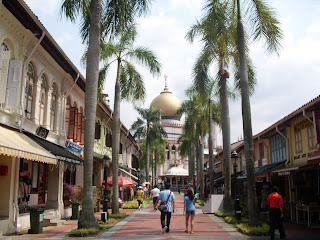
Basra street leading to Sultan mosque
As a result of government’s policy interventions aimed at abolishing village settlements and eliminating ethnic congregation in certain areas, the Kampong Glam is now left with historical symbols as well as heritage shopping and eating, to tell the tale of its past. However, the government is extra conscious to preserve the buildings and streets in its true colours. Since the 1980s, several large portions of the area have been declared National Heritage sites and have been protected for conservation. In 1989, the Urban Redevelopment Authority gazetted Kampong Glam, including the Sultan Mosque, the Hajjah Fatimah Mosque and the Istana Kampong Glam, the palace of the former Sultan, as a conservation area. Moreover, the area is still a key landmark and gathering point for Singapore Muslims and it is for them, especially the Malays, what Chinatown for Chinese and Little India for Indians. The palace of Sulatan (Istana Kampong Glam ) is a heritage museum, the Malay heritage Centre, now showcasing the rich history and culture of Singapore’s Malay community.

Arab street
Sultan Mosque
 Imam Shafeeq and Imam Rafeeq took me to the historic Sultan mosque, a key building and tourist attraction at the end of Bussorah Street. Largest mosque in Singapore with a 5,000 capacity for congregational prayers, the golden domed mosque has many laurels in its credit. It is the only mosque that can use a megaphone outside the mosque for the ceremonial call to the prayers and other programs. Other mosques too use the megaphone, but the sounds should be limited to the compound.
The mosque was materialized when Sultan Hussein, while signing the treaty with Raffles, negotiated to build a mosque near his palace, and the later even contributed $3000 Spanish dollars to its construction. Early in the last century the initial building underwent a reconstruction, thanks to the new design of British planner Dennis Santry who shaped the mosque in the Islamic Saracenic style with domes, minarets and balustrades. According to the information provided by tourist guides at the mosque, designs from Taj Mahal, style from Persian, Moorish, Turkish and a classical theme have been incorporated in the new structure that was completed in 1928.
 Along with Imam Rafeeq Hudawi in front of Sultan Mosque
I returned to a kind of spiritual and traditional fragrance of these streets many times alone during my stay in Singapore in order to get socked in the feeling of being there a hundred or some years ago bargaining with the traders and merchants from all over the world, exchanging great cultures. What an enchanting mood was it while walking through the beautifully restored outlets selling traditional clothes and Malays medicines, artefacts, handicraft, furniture, jewelry, restaurants in addition to an extremely fitting bookshop that sells mostly sufi-oriented classic books and CDs. Muslims generally buy their headgear (or songkok), the holy Quran, prayer mats and manuals from here.
Murtabak At Zamzam
Now both the imams take me into Zamzam restaurant, one of the major destinations for tasty Halal foods, along with Victory and others. Started in the early 20th century, Zamzam is owned by a Malayali family from Kannur district of North Keala, and most of its workers are also from Kerala. As I entered the restaurant accompanying the Imams of the mosque, to whom the hotel sends packed foods many times a month, I got a privileged treatment. Makan ah? . (makan is food and the suffices like ah, lah and leh is a part of Singlish which is a mix of Malay, Mandarin, Tamil and all) They decided to let me have the taste of the special Murtabak, a must-try item in Southeast Asia, of course with all its regional varieties.
 The delicious murtbak placed aesthetically
I wonder hearing the claims that Murtabak is a Malabari cuisine. For Malayalis it is easy to understand that the initial ingredient is the big ball of our Poratta, that egg-sized lump which becomes a large and smooth sheet in about the spade of a minute in the hands of an expert poratta maker. Now without cutting it, unlike what we do to make our poratta, the smooth sheet is stuffed with ground or minced mutton or chicken, chopped coriander leaves, sliced onions and beaten egg along with some other ingredients. The draped stuff will be then put in an oven to serve hot after a short time alone or along with a sauce and gravy.
 tourists at Sultan mosque
In Indonesia I was served with multiple varieties of Murtaba bearing different tastes, and they have special murtaba belonging to various regions and islands, like murtaba Bandung, and they have the sweat variation of Murtaba as well. ‘Food historians’ debate the Malayali origin of Murtaba, and a googling traces its ancestry into Arabia, especially the Higaz region of Saudi Arabia. Friends there should verify this. It says Murtabak is Mutabbaq in Arabic (مطبق) or mutabbag meaning ‘folded’. There is also an opinion that Martabak originated in India, during the Delhi Sultanate and traders took it with them to Southeast Asia. However, to those who still value the oral history, many of my hosts wondered, whenever they served me with Murtabak, saying that how come I don’t know a food with Malabari origin.
Now I could put a full stop thinking that as neo Malayalis carried away the bugs while migrating, the old migrants carried Murtaba away and left no trace of it back in Kerala. Moreover, I got a point for my research, a historic common Arabian or Persian origin for our porotta and their Murtaba.
 Inside Sultan Mosque
 In the Malabar mosque my friends were waiting for me with the tea to discuss the day’s plan. It was interesting to see that the tea meant for me was kept suspended on the wall in a plastic bag, of course, but sorry to say, you will mistake it for a urine bag in hospital, and while seeing it for the first time suspended on the mosque wall, I wondered why this people have attached it in the mosque. Later I noticed that carrying tea or coffee, both hot and cold, in plastic bags and drinking it using straws is a common thing in Southeast.
A Walk through Singapore Muslims’ History
We set out for a morning walk through the Kampong Glam Muslim quarters. Starting from the busy Victoria Street and Jalan Kubur, we passed through Bugis to cross over and reach the story-telling streets named after Muslim cities - Arab Street, Basra Street, Baghdad Street, Muscat Street and Kandahar Street - ending at the imposing Sultan mosque and the Jalan Sultan where my first morning walk, which was exactly a journey to the Muslim past of the Singapore, ended with a delicious cuisine at a Malabari’s hotel.

Along with Imam Shafeeq Hudawi
Jalan Kubur is a small road with a grand and spacious cemetery of mainly Sultans and their relatives at one side and a public Muslim cemetery that is no longer in use on the other. Kampong means Village or settlement in Malay, while Glam is in reference to the Gelam tree, a variety of eucalyptus that was abundant in the area and the bark of which was used by Bugis sailors and boat builders in the Kampong to seal gaps in their bots, while its leaves have the medicinal value. The Malay aristocracy lived in the area before the British East India Company signed a treaty with Sultan Hussein Shah of Johor and Temenggong Abdul Rahman to set up a trading post in 1819. In 1822, when Raffles drew the city’s sketch, he divided the settlement among different ethnic groups like European Town, Chinese, Chulia, Arab and Bugis kampongs. He designated Kampong Glam for the Sultan and his household, in addition to the Malay and Arab communities.

Basra street leading to Sultan mosque
As a result of government’s policy interventions aimed at abolishing village settlements and eliminating ethnic congregation in certain areas, the Kampong Glam is now left with historical symbols as well as heritage shopping and eating, to tell the tale of its past. However, the government is extra conscious to preserve the buildings and streets in its true colours. Since the 1980s, several large portions of the area have been declared National Heritage sites and have been protected for conservation. In 1989, the Urban Redevelopment Authority gazetted Kampong Glam, including the Sultan Mosque, the Hajjah Fatimah Mosque and the Istana Kampong Glam, the palace of the former Sultan, as a conservation area. Moreover, the area is still a key landmark and gathering point for Singapore Muslims and it is for them, especially the Malays, what Chinatown for Chinese and Little India for Indians. The palace of Sulatan (Istana Kampong Glam ) is a heritage museum, the Malay heritage Centre, now showcasing the rich history and culture of Singapore’s Malay community.

Arab street
Sultan Mosque
 Imam Shafeeq and Imam Rafeeq took me to the historic Sultan mosque, a key building and tourist attraction at the end of Bussorah Street. Largest mosque in Singapore with a 5,000 capacity for congregational prayers, the golden domed mosque has many laurels in its credit. It is the only mosque that can use a megaphone outside the mosque for the ceremonial call to the prayers and other programs. Other mosques too use the megaphone, but the sounds should be limited to the compound.
The mosque was materialized when Sultan Hussein, while signing the treaty with Raffles, negotiated to build a mosque near his palace, and the later even contributed $3000 Spanish dollars to its construction. Early in the last century the initial building underwent a reconstruction, thanks to the new design of British planner Dennis Santry who shaped the mosque in the Islamic Saracenic style with domes, minarets and balustrades. According to the information provided by tourist guides at the mosque, designs from Taj Mahal, style from Persian, Moorish, Turkish and a classical theme have been incorporated in the new structure that was completed in 1928.
 Along with Imam Rafeeq Hudawi in front of Sultan Mosque
I returned to a kind of spiritual and traditional fragrance of these streets many times alone during my stay in Singapore in order to get socked in the feeling of being there a hundred or some years ago bargaining with the traders and merchants from all over the world, exchanging great cultures. What an enchanting mood was it while walking through the beautifully restored outlets selling traditional clothes and Malays medicines, artefacts, handicraft, furniture, jewelry, restaurants in addition to an extremely fitting bookshop that sells mostly sufi-oriented classic books and CDs. Muslims generally buy their headgear (or songkok), the holy Quran, prayer mats and manuals from here.
Murtabak At Zamzam
Now both the imams take me into Zamzam restaurant, one of the major destinations for tasty Halal foods, along with Victory and others. Started in the early 20th century, Zamzam is owned by a Malayali family from Kannur district of North Keala, and most of its workers are also from Kerala. As I entered the restaurant accompanying the Imams of the mosque, to whom the hotel sends packed foods many times a month, I got a privileged treatment. Makan ah? . (makan is food and the suffices like ah, lah and leh is a part of Singlish which is a mix of Malay, Mandarin, Tamil and all) They decided to let me have the taste of the special Murtabak, a must-try item in Southeast Asia, of course with all its regional varieties.
 The delicious murtbak placed aesthetically
I wonder hearing the claims that Murtabak is a Malabari cuisine. For Malayalis it is easy to understand that the initial ingredient is the big ball of our Poratta, that egg-sized lump which becomes a large and smooth sheet in about the spade of a minute in the hands of an expert poratta maker. Now without cutting it, unlike what we do to make our poratta, the smooth sheet is stuffed with ground or minced mutton or chicken, chopped coriander leaves, sliced onions and beaten egg along with some other ingredients. The draped stuff will be then put in an oven to serve hot after a short time alone or along with a sauce and gravy.
 tourists at Sultan mosque
In Indonesia I was served with multiple varieties of Murtaba bearing different tastes, and they have special murtaba belonging to various regions and islands, like murtaba Bandung, and they have the sweat variation of Murtaba as well. ‘Food historians’ debate the Malayali origin of Murtaba, and a googling traces its ancestry into Arabia, especially the Higaz region of Saudi Arabia. Friends there should verify this. It says Murtabak is Mutabbaq in Arabic (مطبق) or mutabbag meaning ‘folded’. There is also an opinion that Martabak originated in India, during the Delhi Sultanate and traders took it with them to Southeast Asia. However, to those who still value the oral history, many of my hosts wondered, whenever they served me with Murtabak, saying that how come I don’t know a food with Malabari origin.
Now I could put a full stop thinking that as neo Malayalis carried away the bugs while migrating, the old migrants carried Murtaba away and left no trace of it back in Kerala. Moreover, I got a point for my research, a historic common Arabian or Persian origin for our porotta and their Murtaba.
 Inside Sultan Mosque
Monday, October 26, 2009
My Travelogue: Singapore: Part 4
After a nice and deep sleep I woke up at 4.30am to see Abdullah Haji performing the voluntary night prayer, tahajjud (the Arabic word means the struggle to get rid oneself of sleep). As we bumped in to a man in Indian blue-lined Dhoti while getting out of the lift on our way to the nearby Masjid Hajjah Fatima for Subah (early morning) prayer, Haji told me he is a Chulian. I eagerly asked what Chulia is as he repeatedly used the term. He said it is the name used in Southeast Asia for Hanafi Muslims with Indian origin.
Singapore is home to a notable number of Chulia Muslims, who came mostly as traders and money changers. The name is after the famous Chola Kingdom of Tamil Nadu along the Coromandel Coast. There is a historically important monument called Jamae Chulia Mosque, ironically established in the heart of the amusement hub of Chinatown. Built in 1826, this is the first of three Islamic heritage buildings in Chinatown. The other two are Al-Abrar Mosque and another building in the memory of Seikh Shahul Hamid, the famous Sufi scholar buried in the famous South Indian pilgrim city of Nagore. The mosque is a national monument since 1974, thanks to its typically south Indian entry gate and remarkable architectural style which is a mix of sorts.
The morning prayer at Masjid Hajjah Fatimah was the first experience on the life and culture of the ethnically mixed Muslim community of Singapore. There I met people from various backgrounds and multiple origins, Tamil, Malay, Malayali and even Chinese and Arab origin. The Imam was from Java, a clean-shaved man wearing the typical half-sleeved cream Malay shirt and colored line dhoti. His recitation of Quran was attractive, but he was doing the extra movement back and forth while reciting, a widespread habit generally picked up while memorizing the holy book, but frowned upon during the prayer which is considered nullified by deliberate extra moves according all schools of law. Almost all of the Muslims in Southeast belong to Shafi legal thought, and it is evident especially through prayer rites and rituals observed at the mosque. After the namaz, they sit longer and collectively murmur various invocations and litanies before an emotional group prayer in Arabic led by Imam, like as majority of us do in Kerala, a typical Yemeni-Hadrami tradition spread throughout South India and Southeast Asia, the major point of departure in my research project. The imam asked me to come another day when I introduced myself as a researcher on the way to his native place.
Masjid Hajjah Fatimah is a heritage mosque built by a woman on the Beach Road in the Malay enclave of Kampong Glam district. Built in 1845, the mosque was designed by British architect, John Turnbull Thomson, a fact that explains its European elements along with Islamic ones. It was named after an astute businesswoman from Malacca who married a Bugis prince from Celebes (Sulawesi), and who donated the land, on which her house formerly stood, for the mosque. Undaunted by an early widowhood, Fatima single-handedly managed a huge business through numerous vessels and prows that helped her amass a large fortune. Her only daughter Raja Siti was married by Syed Ahmad Alsagoff, son of an influential Arab trader, Syed Abdul Rahman Alsagoff. The compound of the Mosque includes the graves of Hajjah Fatimah, her daughter and son-in-law. Since 1973, Hajjah Fatimah Mosque is one of the national monuments. Today the mosque is under the Majlis Ugama Islam Singapura (MUIS).
The morning scenes on the way back were interesting as usual. Life was already on showing its multi colors. Various types of people were out on the pathways lined here and there amidst the housing and business complexes, cleaning workers toiling along footpaths, office and school goers, night-duty returners, brisk walkers, dog walkers, couples enjoying the breeze and shadowy climate immersed in their own world, and wrinkled elders - singles , couples and groups - out for pastime.
We walked to a nearby hawker centre passing a Chinese restaurant and a fruit-vegetable market. The smell from the Chinese food court was penchant and unbearable for me. It has always been like that only, when many of my friends go ga-ga over Chinese cuisines, I have yet to cope even with its smell. They were eating all kind of things, including meat and fish, right from the early morning. Abdullah Haji took me to his regular vendor, a devout Bangladeshi, and we had a delightful tasty tea in a big cup along with a bun. The pulled tea 'teh tarik', sold at 80cets, is made with sweetened condensed milk. While having the tea as well as getting new and new information from Haji, I looked around the hawker centre, one of the popular food courts meant generally for ordinary people. The concept of the hawker centre is open-air complexes housing many stalls selling a variety of inexpensive food. Found near public housing estates or transport hubs, hawker centers are another display of the multi-ethnicity of Singapore. Stalls representing all from global and cultural colors and run by people from various backgrounds are available under one roof. Some stalls are exclusive for some items. Jointly owned by the National Environment Agency (NEA), Housing and Development Board (HDB) and JTC Corporation, and managed by NEA, the public hawker centre system is the best way to maintain hygiene in cheap-eat centers, a best idea countries like India can learn a lesson from. In almost all Indian cities cheap public eating is always risky and dangerous, but hugely popular. We are always used to neglect the filthy and dirty situations at our roadside Dhabas, not to mention the problem of unhygienic food preparation by unlicensed street hawkers.
Singapore is home to a notable number of Chulia Muslims, who came mostly as traders and money changers. The name is after the famous Chola Kingdom of Tamil Nadu along the Coromandel Coast. There is a historically important monument called Jamae Chulia Mosque, ironically established in the heart of the amusement hub of Chinatown. Built in 1826, this is the first of three Islamic heritage buildings in Chinatown. The other two are Al-Abrar Mosque and another building in the memory of Seikh Shahul Hamid, the famous Sufi scholar buried in the famous South Indian pilgrim city of Nagore. The mosque is a national monument since 1974, thanks to its typically south Indian entry gate and remarkable architectural style which is a mix of sorts.
The morning prayer at Masjid Hajjah Fatimah was the first experience on the life and culture of the ethnically mixed Muslim community of Singapore. There I met people from various backgrounds and multiple origins, Tamil, Malay, Malayali and even Chinese and Arab origin. The Imam was from Java, a clean-shaved man wearing the typical half-sleeved cream Malay shirt and colored line dhoti. His recitation of Quran was attractive, but he was doing the extra movement back and forth while reciting, a widespread habit generally picked up while memorizing the holy book, but frowned upon during the prayer which is considered nullified by deliberate extra moves according all schools of law. Almost all of the Muslims in Southeast belong to Shafi legal thought, and it is evident especially through prayer rites and rituals observed at the mosque. After the namaz, they sit longer and collectively murmur various invocations and litanies before an emotional group prayer in Arabic led by Imam, like as majority of us do in Kerala, a typical Yemeni-Hadrami tradition spread throughout South India and Southeast Asia, the major point of departure in my research project. The imam asked me to come another day when I introduced myself as a researcher on the way to his native place.
Masjid Hajjah Fatimah is a heritage mosque built by a woman on the Beach Road in the Malay enclave of Kampong Glam district. Built in 1845, the mosque was designed by British architect, John Turnbull Thomson, a fact that explains its European elements along with Islamic ones. It was named after an astute businesswoman from Malacca who married a Bugis prince from Celebes (Sulawesi), and who donated the land, on which her house formerly stood, for the mosque. Undaunted by an early widowhood, Fatima single-handedly managed a huge business through numerous vessels and prows that helped her amass a large fortune. Her only daughter Raja Siti was married by Syed Ahmad Alsagoff, son of an influential Arab trader, Syed Abdul Rahman Alsagoff. The compound of the Mosque includes the graves of Hajjah Fatimah, her daughter and son-in-law. Since 1973, Hajjah Fatimah Mosque is one of the national monuments. Today the mosque is under the Majlis Ugama Islam Singapura (MUIS).
The morning scenes on the way back were interesting as usual. Life was already on showing its multi colors. Various types of people were out on the pathways lined here and there amidst the housing and business complexes, cleaning workers toiling along footpaths, office and school goers, night-duty returners, brisk walkers, dog walkers, couples enjoying the breeze and shadowy climate immersed in their own world, and wrinkled elders - singles , couples and groups - out for pastime.
We walked to a nearby hawker centre passing a Chinese restaurant and a fruit-vegetable market. The smell from the Chinese food court was penchant and unbearable for me. It has always been like that only, when many of my friends go ga-ga over Chinese cuisines, I have yet to cope even with its smell. They were eating all kind of things, including meat and fish, right from the early morning. Abdullah Haji took me to his regular vendor, a devout Bangladeshi, and we had a delightful tasty tea in a big cup along with a bun. The pulled tea 'teh tarik', sold at 80cets, is made with sweetened condensed milk. While having the tea as well as getting new and new information from Haji, I looked around the hawker centre, one of the popular food courts meant generally for ordinary people. The concept of the hawker centre is open-air complexes housing many stalls selling a variety of inexpensive food. Found near public housing estates or transport hubs, hawker centers are another display of the multi-ethnicity of Singapore. Stalls representing all from global and cultural colors and run by people from various backgrounds are available under one roof. Some stalls are exclusive for some items. Jointly owned by the National Environment Agency (NEA), Housing and Development Board (HDB) and JTC Corporation, and managed by NEA, the public hawker centre system is the best way to maintain hygiene in cheap-eat centers, a best idea countries like India can learn a lesson from. In almost all Indian cities cheap public eating is always risky and dangerous, but hugely popular. We are always used to neglect the filthy and dirty situations at our roadside Dhabas, not to mention the problem of unhygienic food preparation by unlicensed street hawkers.
Saturday, October 17, 2009
Love for Jihad Or Jihad for Love
Heartily congratulations to the proud JNU Students Community who sternly rejected another heinous attempt by the regressive, hopeless and divisive forces in the campus, with an apparent support from outside, to malign the healthy, pluralistic, cordial and accommodative atmosphere of this prestigious campus through a couple of ill-intended, venomous and vitriolic pamphlets.
Accustomed to fish in the dirty water, self-assured or misguided that a call for flesh and blood of minorities are the best way to practice cultural nationalism and an eventual establishment of a Hindutva state, these desperadoes never deserve even a response to their heinous acts.
We have seen more of these in the past, witnessed its culminating orgasm in the post-Babri 90s, and have got assured that the majority Hindu brothers and minorities stand united to uphold a secular and democratic country, more concerned with its inclusive development.
However, as the entire target of this well-planned character assassination were a particular community, we, some concerned students thought to clear the air and do our part sincerely to avert any potential negative consequences of such dastardly efforts in vitiating the existing unity in diversity of our beloved campus.
In the immediate backdrop of such a sadistic ‘Sanghi Daharma’ exposure we see many things from the Sangh Parivar’s calamitous debacle in this year's election that indicated to a frightening desertion of the party by its general vote base of urban middle class as well as to the unending problems of the Sangh party due to an ageing and week leadership and vicious back-stabbings and in-fights, to a Remarkable erosion in the interest of parents to see their wards in the awkward and pre-modern kakki-knickers.
More importantly, the relentless attempts of Sangh mafia to paint the minority community black and to establish the ‘all-terrorists-are-Muslims’ theory through fake encounters and a number of dubious and mystery-shrouded attacks and explosions, obviously exploiting all the government machineries, were well exposed by the powerful secular forces of the country to the utter disappointment of these people. Now the Sangh is once again going back to its basis – evoke communal frenzy, spread hatred, divide the society through victimization and vilification of a particular community and seek the way to power.
The entire ‘Love-Jihad’ episode has underlined the ability of Sangh Parivar to spread a lie as truth and utilize it for fomenting communal violence. On first March, 2002, Gujarat’s Sandesh newspaper reported that a group of Godhra Muslims have abducted two young Hindu girls, raped them in turns, sliced their breasts and threw them in a nearby canal. The police force made an extensive search, investigated in detail, found that the entire story was cooked up to maximize the destructive effect of the ongoing post-Godra violence.
The newspaper later pretended apologizing through a three-line report, but all the intended damages were over by that time. The Sangh Pariwar spread the story all over Gujarat fanning the revenge and inducing their activists to employ the most heinous methods of killings, widespread rape, immolations of children and women and even taking out of fetus from the womb of a pregnant woman. Now we see the same people spreading some imagined stories sexed-up by their counterparts in Kerala.
Love inside and outside the campus irrespective of religion, and subsequent inter-religious marriages are nothing new, especially in Kerala, where there is more mingling between communities and less or no ghettoisation of particular religious groups. In most cases, there have been initial tensions in the families, obviously due to inability of the parents to cope with the fact, given the social and religious realities. Conversion is in fact a painful experience for the families involved.
However, there are thousands of mixed families in Kerala and elsewhere who have survived these initial obstacles and keep living, in some cases even in the same villages as of their families. Amazingly, there was no big hue and cry in Kerala when a Muslim girl, whose historic first rank in SSLC public exam was highly celebrated by each and every Muslim organization in the state, decided to live a marital life with her Christian boyfriend she met while studying MBBS. Generally, when such issues reach to police stations and courts, the will of the adult girl is asked and she is allowed to go accordingly.
However, in the controversial case involving two MBA students of Pathanamthitta Pokkanam St. Jones College, who fell in love with their Muslim boyfriends, they were compelled to go with their parents, without considering their repeated requests to go with their lovers. One of them had even called a press meet in Kottayam to clarify that she married her Muslim lover on her own will, and no one had converted her forcefully.
The reported change in the tones of the girls came only later, after the family got enough time to brainwash them. The picture and drama behind the ‘Love-Jihad’ episode becomes clearer when one knows that the Hindu girl belonged to the family of a top state BJP leader, while the Christian girl hails form the family of a high ranking police officer. More interestingly, Shahansha, the other boy involved, was the district president of MSF, the student wing of State Muslim League, which is well-known in the state for its strong stances and measures against all extremist forces among Muslims. The handsome boy was also a hero in the campus.
A state BJP leader traded blind allegations and distributed spicy stories of “love-jihad’ in a press conference. Suddenly everybody from the court and police to Christian leaders started speaking in the tongue of Sang Parivar. The Catholic Church in Kerala alerted parents and teachers about an ‘extremist Islamic strategy to convert young women through marriage’, adding that ‘movement is a network of organized young and handsome Muslim youths to lure girls, make them pregnant and dump them’. Shamelessly, it even announced a plan to organize defensive and corrective measures in co-operation with VHP against the actors in of this imagined tales.
Let’s look why anybody fail to believe these cooked stories. All from Sangh Parivar, the Catholic Bishops Council and the police now say that there are zonal offices under a chairman for the ‘Love-Jihad’ or ‘Romeo Jihad’ outfit in all the 14 districts of the state, and it has been working for long with the help of ‘terror funding’ by many international terrorist organizations. The outfit has already converted around 4,000 hindu and Christian girls. However, one wonders that then how come the entire security apparatus, which had extensively scrutinized each and every Muslim family in the state in the wake of recent controversy regarding ‘terror recruitment to Kashmir’, could not get any tip on the existence of this ‘highly active Love-jihad’ force before this incident.
There are many boys and girls who fall in love and marry non-Muslims, and it is well-known that generally these people happen to be less performing, willing to get out of the religious rituals and mores, interested in living a cool, happy and loose life. They usually get the wrath of religious authority for being ‘irreligious and lax’. It is the last thing to imagine about them that they are jihadis doing love to increase the number of Muslims. So far those practicing Muslims with caps and beards were the main terror suspects, now one of the immediate consequences of this propaganda will be targeting of these pleasure-loving, happy-going less or no religious Muslim youths, who generally happen to be the main link among communities.
Lastly and more importantly, the term love-jihad itself is self contradictory and abusive of its true religious meaning. ‘Jihad’ is striving hard in the struggle against one's own self, controlling of ill deeds, ill-words, and even ill thoughts and intentions. A true Muslim’s entire life should be an unending endevour to succeed in this ‘jihad’ so that he can be a shining light for all others.
Romantic Love in the eye of Islam is both prescriptive and proscriptive. Prescriptive and highly rewarded when it is intensely shared between the husband and wife. Proscriptive when is shared between two opposite sexes out of the marital bliss. The real relation between a male and his non-related girl should be that of mutual respect, and any kind of sexual overtones are discouraged in such a relation.
“Say to the believing men that they should lower their gaze and guard their modesty; that will make for greater purity for them” “And say to the believing women that they should lower their gaze and guard their modesty” (Quran: Nur: 30-31). ‘So a brazen stare by a man at women (or even at a man) is a breach of refined manners’. One has to strive hard to get this value, and Islam says it is the true jihad. How far and contradictory is this and using the same word to lure girls, abuse. Love does happen among Muslims also, but there is no way for any kind of religious interpretation to endorse it, let alone to use it as a weapon for conversion.
Subscribe to:
Posts (Atom)